Tuesday, July 5, 2022

1d8 Spellbooks

I usually throw lore into my spellbooks, stories, tidbits, other shit. And Wizards should be masters of lore,  so it's good to feed your wizards lore. As an important kind of loot for your Magic-Users, it's a better bet they'll actually read this and thus use that lore. 

Levels: Each book a level from 1-20 usually corresponding to the level of the wizard who wrote it, to help you determine what strength of spells to include in the book. 

Code: Every spellbook is different, and without time and effort only makes sense to the book's author. Sometimes this is just a specific notation system and shorthand, other times it's much more obnoxious, memetic type shit. If "none" assume it's in common or whatever your setting's Lingua Franca is. 

1. Of Concoctions and Preoccupations: 

    Level:  5th

Content: Basic potion and alchemy work, as well as a variety of useful and popular spells (Evocation stuff, mostly). 

Author: Blazbus The Wise. Middling, but respected, court wizard. 

Code: Simple and Mathmatical 

2. "How To Get What You Want" 

    Level: 6th 

Content: Basic magical college manual on enchantments and other utility spells. Has some troubling content regarding justifications for Mind Control.

Author: only attributed to "An Elf"

Code: None

3. "Sorbo’s Spellbook"

    Level: 8th

Content: Magic illusions and party tricks, and non magic illusions and party tricks. Also contains colorful suggestions for using so in both entertainment and tactical situations. 

Author: Sorbo, young and promising illusionist who published the book to mild acclaim. Sadly his career was cut short via death from 333 types of syphilis.

Code: None, but written in invisible ink. Need to spray it with lemon juice and bake it in a low temp oven for a few minutes. 

4. "Household Spells for the House-Wizard!"

    Level: 3rd

Content: Basic cantrips and other mostly useless spells.  Comes out of a strange and controversial wizard domestication movement, ala the Stepford Wives. It might actually be a training manual for wife-golems or perhaps just a weird fetish thing. 

Author: Gregg The Greater, headmaster of St. Herring's Magical State College

Code: None, but extremely patronizing and thus hard to read. 

5. "2" 

    Level: 10th

Content: Spells for flight, spells for killing (particularly the explosive kind) and some transmutational magic. Also goes into no small tirade about the effectiveness flying above foes and dropping anvils and other heavy things on them.

Author: "The Mad Major" Distinguished and insane wizard who found ample employment on the battlefield. Loved to do that anvil trick. 

6. "A Backup"

    Level: 20th 

Content: Has little notes, research work, or journal entries, simply a repository of spells. Mostly transmutation, some utility, and some biomancy magick. 

Author: Travis, the infamously cruel and powerful biomancer. This book is likely guarded by some godawful fleshbeast. 

7. "The Arm of Skellemancer Gorl" 

    Level: 15th

Content: Literally just an arm, needs to be grafted onto a body or swapped with a limb, already a risky procedure. Once it's got living blood in it's veins it will act as a normal arm, but when given empty pages in a spellbook will auto  write dread and terrible(but powerful!) necromancy spells. If grafted for long it will attempt to take over the host, and Skellemancer Gorl will live again. So be careful if you graft it to a lab monkey or something.

Author: Gorl was a bad, bad, bad, boy. 

8. "The Holy Bible"

    Level: Whatever level that cleric you just killed and looted 

Content: Spells disguised to look like miracles or divine casting. Heretical theories and code phrases to identify secret agents.

Code: The surface this looks like a bible (or whatever your settings equivalent is) but strange sections are scribbled over, circled, or reference each other in weird ways. 

Author: Whoever this dead cleric was, he was probably a wizard in disguise. Or maybe just up to some weird shit.

Sunday, February 7, 2021

Spell Modification Mechanic: Grimoires

 Grimoires, the culmination of a wizard's research, are the study of spell modification and  improvement. A grimoire is different than a spell book, but they often go hand in hand, and can even sometimes be two separate parts of the same tome. Spellbooks are a place to store the methods and info needed to cast a spell. Grimoires are a text that either changes the function of a spell slightly, or improves it overall. They are never changed enough to be worthy of an entirely new type of spell. 

After studying them for a certain amount of time a  player's Wizard can learn the modified spell and prepare it as they would the original spell. At the beginning of their spell prep time they can choose their spell slot for either the original spell, or the modified version, they can't be changed on the fly. 


While spell rulings will likely differ, I'll pick a common one here as an example:

Magic Missile, in the most commonly creates a magical energy blast deals a 1d4 of damage for each missle summoned, more misses are summoned per the caster's level, usually with a cap of 4 or so. Usually the spell also requires no rolls to hit, it just magically seeks the target and does the damage. 


Grimoires that are a trade-off: (roll a 1d6)

1. Blood Magic Missile:

Using your own blood in the creation of the spell, you amplify it's damage. The damage of the missile is upgraded to the next dice, (so a d6 instead of a d4) but for each missile casted in the spell, you take a d4 of damage. (so if you cast 3 d6 missiles, you'll take 3d4 damage from blood loss.) 

Pretty straight forward, right? do some more damage but take some in return. 

2. Concentrated Magic Missile:

Instead of casting multiple missiles, you make a single, stronger missile, with an extra dice for every missile you would have casted otherwise, plus one. (so instead of 4 separate d4 missiles, you would make a single missile that deals 5d4 damage) 

3. Ice Magic Missile:

Increases the damage to the next dice (d4 to d6 as before) but deals cold damage instead of it's normal, magicky kind. Probably looks like icicles or some rad shit too. 

In pathfinder (I know, I know) Magic Missile deals force damage, which is effective against most monsters, so by making it cold or ice damage there's a greater chance things are resilient to it, but gives you more overall damage as a trade. (And rewards planning, if they find out a monster is weak to ice, they can prep this spell!) Feel free to replace this one with literally any other element or damage type. 

4. Tangible Missile:

 By tying the missiles to the material plane more closely, can make more of them. Double the amount of missiles you would usually make, but you need to make a successful ranged attack roll to hit each missile. 

5. Bane Missiles: 

When preparing the Magic Missile, designate a creature or humanoid type that the caster is familiar with, (may require a successful knowledge or lore roll) and the missile will deal +1 damage per missile to targets of that kind, and -1 damage to everything else. (So a Bane (Elf) Magic Missile will deal 1d4+1 to elves, and 1d4-1 to whatever else)

6. Non-lethal Magic Missiles:

Deal non-lethal damage, or just are incapable of killing. they always deal -1 damage per missile, however.

Combo-spells. If a player has multiple grimoires, they can often combine them for greater effect. Anything that upgrades hit dice stacks. So if they cast a blood and ice Magic Missile, they fire blood infused blood icicles, and it deals d8 for each missile instead of the d4. (they still only take d4 per missile in damage, probably)

Grimoires that are straight-up upgrade:

Since these are strictly better, I usually make them much, much harder to find. If you aren't comfortable with, they can always upgrade the slot or cost of the spell. (If magic missile is usually a 1st level spell, now make it a 2nd or 3rd, or whatever)

(Roll a 1d4)

1. Hyper-Geometric Magic Missile: 

Using sacred geometric shape the formation of the missiles, they have a greater propensity to cause more destruction The dice is just straight-up upgraded to the next level. 

2. Revealing Magic Missiles:

If a target struck by a Revealing Magic Missile, they must make a will save or the caster will know their alignment (or maybe just a secret about them)

3. Razorite Magic Missiles: 

When the missiles deal damage to a target, the target begins to bleed 1 point of damage for each missile struck with. It stops when the target receives magical heal or can take time to bandage themselves. 

4. Goo Magic Missiles: 

Deals damage, but also each missile leaves behind a heavy residue, adding ten pounds of weight on the target, per target. Can be washed off with water. 


I hope you get the idea. Depending on the spell you can get pretty creative, have stone walls grow arms and attack, have a fog spell be made out of gelatin, make a Knock spell quite but also make your teeth itchy. 

Grimoires have been a hit in my games, I jive with the idea of horizontal leveling (powering up in ways that aren't a level up). My players like the added strategy, and it can be a fun way to add flair and character to a caster. (Of course the powerful ice mage would make his magic missiles ice-themed.) Another thing is: grimoires can survive a player character's death. The caster may die, but his book collection lives on, and can benefit future casters in the party. This also gives magic users a desire to find ancient tomes an' shit which is a good thing. 

Friday, October 2, 2020

Of Symbols and Suffering

I've slowly been building a mass of things good for filling your dungeon. I think one day I'll collect it to make a PDF.

Magic Symbols: 

Symbols of Death, of Insanity, of Clownification, or of Un-scratchable Itch. Whatever they do, they interest me. I think they are a good case study for how to make a good trap.

Depending on your system they can be activated in a ton of ways, but I wanted to focus on the symbols that activate upon being closely looked at. This is very contradictory as often the best way to determine if something is dangerous is, well, by looking at it. Therefore I think the distinction of close inspection as opposed to just looking at it is important.             

All my symbols look like these.
 Example: 

The party looks down a hallway and sees a strange symbol at the end of their light sources. It's a symbol of death! Save or die! 


That's not fun.
Here are some people smarter than me talking about traps. Traps often teach a lesson about the dungeon they are in, and about you as a DM. If you throw in symbols in that are triggered by a glance, you are telling your players that to succeed they should never look at interesting, magical-looking things, and looking at interesting, magical-looking things is like 90% of my games. 

The there should always be a warning that something is going on, if a party sees a glimpse of a symbol and decides to ignore the warnings and inspect it anyway, go ahead and make them suffer the consequences. If the party is careful and smart (or like to sacrifice hirelings), they can circumnavigate the symbol and maybe even use them against their foes. 

Once a symbol is detected, it doesn't go away, and that makes things interesting. How does a thief pick a lock on a door that has a big old symbol of pain on it? How do you fight a random encounter in a room where you need to close your eyes? 

In Summary: First: trap symbols cane easily become unfun, so think about what lesson they teach as a trap. Second: symbols that trigger on sight should trigger when looked at closely, not just at first glance unless you have a very good reason. Third, detection of a symbol can be where the fun begins; now they have to get around it or figure out how to exploit it. 

Cool, so after all that nonsense ranting, here are some of mine. 

All of these symbols detect as magical, and with a roll can be identified as a certain type of magic, (usually something scary like necromancy) they will look strange and arcane, maybe they glow,  whatever you need to get the point across. ("When in doubt, throw dead bodies about"; your players can never complain about a trap if there are dead bodies from said trap lying around) 

 The Reflection Trap: There are arcane looking drawings on the wall and there is a reflective surface on the ground below it; a reflecting pool or mirror. Nothing happens while looking at the nonsensical scrawling on the wall, he symbol is only activated upon looking at the reflection below. 

 1. The Goblet Trap: A big fancy cup, filled with liquid, on the inside of the goblet is the symbol, obscured by the liquid. Once the liquid is removed, (as say, someone drinks it) the symbol can be seen and thus activates. A hasty party may detect magic and only assume the magic coming from the symbol is from the liquid, spelling doom for the quaff-er. If you're feeling nice make the liquid semi-transparent; the water refraction is enough to prevent the symbol from going off. Then, the shimmering image can give another hint that something is off. 

2. The Clean Up Trap: The Symbol is just covered by something. Dust, blood, trash, work, but I like this one as a punishment for greed. Have it be covered by a vein of a valuable mineral (and be accompanied by a rude phrase describing dwarfs) or simply a floor filled with gold coins, take a lot and walk home rich, take them all and save or die. 

3. The Sliding Puzzle Trap: Unless you're going to actually make a sliding puzzle like this one crazy DM I knew, don't make them do one via descriptions or something. Just an intelligence test to see if they can do it quickly or risk taking either too much time or a random encounter or something. Once the puzzle is all put together, time to make a save, it was a symbol all along! Like the others a detect magic and the strange, arcane nature of the image they were putting together should be enough to warn the party.

4. The Thematic Trap: Symbols are obscured in some way that has to do with the dungeon. Maybe this is the tomb of paladins that hunted devilkind, so they put symbols that are only activated when read and understood by those who understand hellspeak, thus deterring devil-worshippers who seek to defile their tombs. 

5. The Different Perspective: Early in the dungeon, the party comes to a large room with a high ceiling, think a spire of a wizards tower or something. The floor is completely the tell-tale runes of something magical, but is incomplete: nothing happens on its inspection. However above there are other platforms or objects that complete the symbol (like a bridge, floating platform, or chandelier) and when the whole room is viewed from above, the symbol is activated. Put something valuable at the top of the ceiling and watch the party scramble to catch whatever fool climbed/flew up there and looked down!

 (Side note: a good early warning for this one is dead bodies all over the bottom floor, people who looked down from higher up and fell down to their deaths as the symbol affected them, figuring out how all these people died from falling will be interesting and paranoia-inducing)

6. Don't Look Up!: The Symbol is on the ceiling, and there are reasons to look on the ceiling, maybe it's gold trimming that can be chipped away, maybe it's smug goblins armed with crossbows and rude remarks. (Murder-holes and trapdoors make sense, but i like the idea that they just duct-taped themselves up there.) 

A final final caveat: players using symbols don't necessarily need to be held to these kinds of rules. It is easy for a DM to get the party to look at things, it is harder for a character to get an NPC to look at something. Therefore symbols that fire off at a quick glance are more permissible for the players as opposed to the DM, in my book at least. 


The Key of Solomon is full of Rad Shit

Thursday, July 2, 2020

The Formation of Pantheon


I've been dreaming of a post-apocalyptic bronze age setting for awhile now, something like Dominions 3: The Awakening meets The Land of One Thousand Towers (from ASE). Replace the wizards with gods and tone down the gonzo a little (only a little) and you pretty much got it. I'd probably wind up adding guns and ruining everything as I usually do, but it did get  me thinking about old-school pantheons and how they were formed, and thus it's time for a lil history lesson.


Waaaaay back in the day when the good old cradle of civilization was still cradling civilization, each early city had its own patron god, who usually was believed to live directly in the temple.


That large Ziggurat is where God lived


The temple was the biggest thing in your city, it was what everyone prayed to, and it was the first thing visitors saw when coming into your city.

 Now of course, what was the best way to understand which city was the most powerful? 
By who had the most powerful god, of course.
And how did you tell which god was the most powerful? 
By how big, pretty, and impressive looking that god's temple was.

Citizens Bank Park: A Decade in the Stadium We Didn't Want
By the way, I gotta teach this the way it was taught to me, with sports
Now in obviously it was the other way around, the most successful city economically or otherwise was the one with the capability to provide their god with a nice place, so it was all just classic dick waggling. Nevertheless, this is one of the ways religion went from just being important for rituals, lessons, culture, etc. to being important politically and strategically.  It's how you impressed traveling merchants, and maybe even kept people from fucking your shit up. 


Cities of Mesopotamia // history of architecture – architect to be
However, the lone city wasn't a thing forever. Eventually empires formed, some cities and rulers got so big they could conquer and control other cities.
But when you take over a city, what do you do with the god that lives there?

 It's not easy to get everyone to just switch over to your god, and you can't really kill a god so that temple probably isn't going anywhere anytime soon. The solution is: you connect the gods. Maybe Babylon's Marduk is (all-of-a-sudden) the sibling of  Uttu from Nippur. Then later Marduk gets a brother, or was the father to another god, or is the son of an older god from some other city. As more cities are conquered, as the cultures are mixed together, the Pantheon forms. The stories intertwine, gods get absorbed into other gods and a bunch of other even more messier shit.
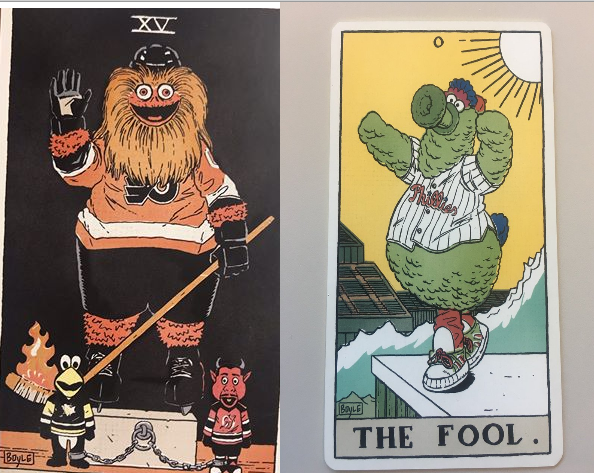
These tarot cards are pretty alright
That's the gist of it, I like the idea of taking this literally, and having a setting where a conquering tribe or general could collaborate with his patron god to conquer other temples, subjugate their gods and gain their boons and powers to further your conquest. All the gods would be super esoteric: obelisks, ever-burning willow trees, angry statues with glowing eyes, a big weltmaschine thing where every visitor has to donate a trinket to its ever-growing mass. They can't manifest in the world, but can present omens and grant powers, and direct rituals that can cause plagues and curses and shit. I imagine lots of old-testament pillars of fire and city walls collapsing type shit. Maybe if you get their temple big enough they can create apocalyptic world changing events, like the sky always rains blood that burns non-believers or something. 


A final note: 
Hokey sports analogy aside, this kind of "pantheon making" (scyricism is the better word) happens throughout all of history. As religions got more complex (and monotheistic, particularly in the west), so did the processes in which they were blended. Shinto blending with Buddhism, Christians having holidays line up with pagan solstices and rewriting parts of Beowulf  are ones that come to mind. Some random more modern examples would be Hoodoo, Catholicism in Mexico and Guatemala, and Cheondoism.

I hope my meager training at history can help you think about your table-top stuff differently, if you dig this kind of thing check out the first one I did, about time and the apocalypse 

Thursday, August 29, 2019

High Elves and Low Elves

If you were immortal, how would that change how you live your life?

Elves do not die of old age. They can be murdered, however, and are susceptible to most diseases. These last two facts are why humans have been able to wrest control of the world from elves in the last few hundred centuries. Nevertheless, there are elves who count among the oldest living things in Oris, and with such vast amounts of time often comes knowledge, power, and opportunity. The most powerful among such elves are known as High Elves.

When you hear High Elf you pretty much get the picture on what I'm talking about, powerful immortals with wide spread influence or power, probably magic users, etc. Their intellect is far sweeping and their machinations unfathomable to the mortal brain. The only real difference between my high elves and most is that it's not really a race, more of a choice.

To be a High Elf is to insert yourself into The Game, which I keep talking about and will get into sometime. Basically it's a war between every long lasting immortal, dynasty, secret organization, and even every idea on the planet.

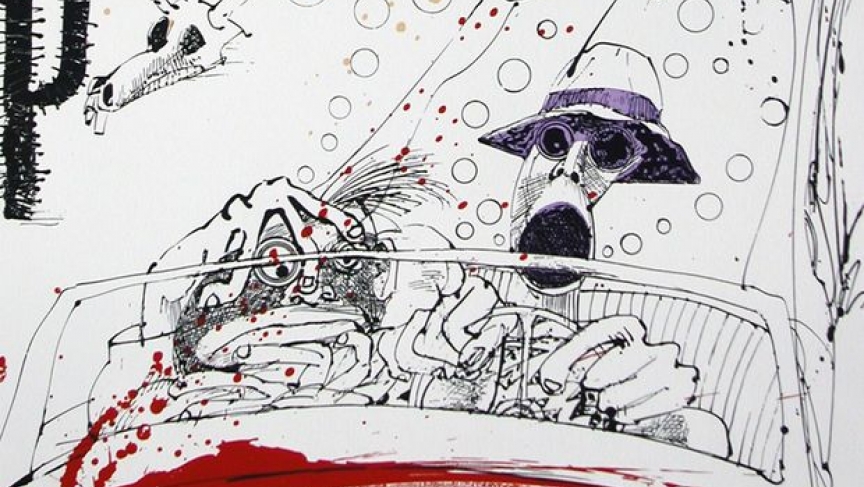
Ralph Steadman
When a elf believes that they have gathered enough experience, power, or some other form of leverage, they may declare themselves to the local Elven community as a High Elf.  Within a week, the assassination attempts should come, if anyone actually respects them. It's considered VERY disrespectful to not have assassins sent after you by other High Elves.

High Elves have wide-sweeping, century spanning plans, their conflict between each other is both very clandestine and very orderly. Political and institutional warfare, puppet rulers behind puppet rulers, spells and rituals on a massive scale but a slow, subtle pace. As long as they play their cards right, they will be there when everything else is not, so then, should they not be entitled to shape what is rightfully theirs?

Most elves never survive to be high elves. Some do, and choose not to. Some have the same level of power, knowledge, and experience required, but become Low Elves.

The Low Elf is the complete rejection of The Game, of society, of existence. The Low Elf is the Dada artist, the gonzo journalist, the nutter living in a barrel down the street from you who can kill you with a look.

While the High Elf seeks to rule the world, or unfold some grand scheme, Low Elves seek artistic fulfillment, esoteric experiences, or just pure hedonistic pleasure. Low elves exist in complete rejection of policies, rules, and purposes of their brothers and sisters. Immortality has not given them purpose to shape the world into a place that they see fit, instead it has made them bored, and they're gonna get real weird with it. I think this is really what the difference boils down to, the question of; "If I live forever, what do I do?"

Both types of elf can be excellent allies or quest givers to a party, as well as antagonists. A Low Elf might be a fun guy at a party, paying for a new kind of psychedelic, or a journalist seeking to upturn a regime. They also may be a serial killer, or a wizard who wants to decimate a town for aesthetic purposes.

Occasionally, low elves can have as wide-sweeping influence and plans as a High Elf, and the difference between the two is sometimes impossible to spot, it's really just a matter of branding and intent.

High Elves fucking hate Low Elves.
Low Elves mostly don't care what High Elves think. Those that do find it hilarious.

Saturday, March 30, 2019

THE DEAMON DRINK (d8 and d6 Random Beverages)

Recently I had my players in a bar, as you often have your players.
 They asked me what was on tap, or if they could see a cocktail menu.
"uhhhhhhhhh"
 Like an IDIOT, I hadn't planned farther ahead than beer or ale.
Never again.
Here's a list of booze with a little lore (and some historical rants) to go along with, but as always, take whatever you want.

"Mundane" Beverages: Only minor magical effects at best.
  1. IMB Special Reserve: The Iron, Misery, and Blood Corporation is a terrible, East Indian Tea company-esque organization run amok. This hyper-manufactured, watery beer is the only drink served in areas they control, and the only beer their employees are allowed to drink. Wise barkeeps in zones near contested corporate zones keep bottles of this stuff around, in case a party of executives decide to visit. Not only does it avoid class-action lawsuits, but you can just kinda fill it with whatever, no corporate slave would dare make a comment about it tasting different (better) to his boss.
  2. A Cut of Purity: A melted chunk of an iceberg, taken from the very, very cold north, outside Polis, home to the Temple of Law, one of the most boring and bureaucratic places on earth. It's simply the purest water on the planet, which stays permanently chill. Devils find this extremely intoxicating, but for most humanoids it has little effect other than the being the drink of choice for designated drivers or un-fun Lawful Goods.
  3. Last Empress Absinthe: Absinthe is an anise flavored liqueur that many say tastes like licorice (though personally I
    Albert Maignan, La Muse Verde
    find it a bit more complex than that) You may have heard stories of Absinthe being hallucinogenic, however if you were to try some today, you would be pretty disappointed. The old school absinthe was often made in a toilet, and had all kinds of fun ingredients, like embalming fluid. It was extras like that which was making french artists to go mad in the streets. And when the good constable demanded to know the reason behind your drunken relatively? Were you gonna say you were drinking toilet hooch? No, the green fairy made you do it. By the way, Last Empress Absinthe is a toilet hooch that is totally loaded with all types of crazy shit. Fort save or black out, and wake up in some sort of trouble of the GM's choosing.
  4. Hanlon's Mushroom Wine: Distilled from pulped mushrooms from your local cave, underdark society, or post-apocalyptic moon wasteland. Murky, awful, and viscous, but the fungi particles seem to stick to your stomach, keeping you blissfully drunk for far longer than your standard libation.
  5. Rose Brandy: in some corners of Oris, the rapid industrialization which has ruined all creativity in wheat beverages and forced people into drinking things that make them go blind/lame (see #3 or here) has not touched parts of the world. Here the craft of making alcohol is still celebrated in style. Villagers in the north, near the lands of the Burning Dove still celebrate tasting days, where they gather around their stills and taste the product gradually until its ready. (This tends to take all day, for some reason) In many ways is analogous to the craft beer/liquor movements we see popping up all over the place. 
  6. Salt of The Earth: A fermented drink made from dark bread. Worm-like grubs that produce ethanol are introduced to intensify the alcohol content. Any good brand will have a single (still living) grub left at the bottle. 
  7. Goblin Vomit: They keep 'em in the basement, feed 'em lots of sugar. The worst beverage.
  8. Och're Valley: Expensive tasting wine, though never goes for more than a few gold. Crushed cherry and chocolate-like flavors, medium body. Good starting wine.  At one point, the Cult of The Burning Dove banned all alcohol in their territories, and proceeded to burn down every vineyard. One family pleaded clemency when the inquisitors came to their chateau. Their son, they said, was a minor warrior saint. He came home from a great battle mortally wounded, and his blood soaked into the ground. Eventually, the blooded soil began to grow grape vines. The inquisitors were moved, and thus the oldest vineyard in Oris still exists today. When drunk it tends to remove inhibitions more drastically than other, in excess compared to other alcohol. Quaffed in large amounts, total ego-death, in the Jungian sense. 

Magical Beverages: These are pretty rare, only one per bar, or alternatively, as treasure. 
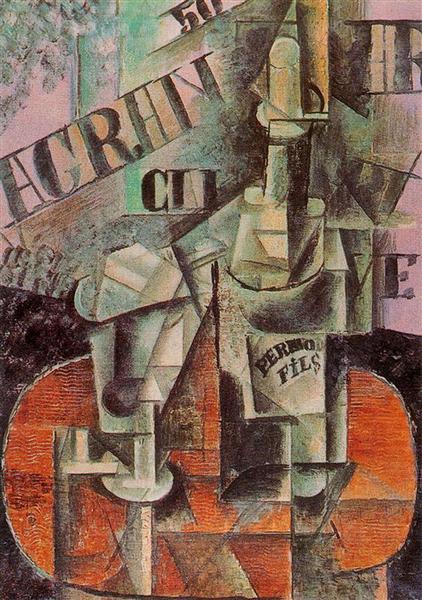
Picasso, Table in A Cafe
  1. The Firebreath Challenge: A supremely spicy beverage, which burns the throat somethin' fierce. There is no flavor here, only pain. Anyone who wishes to pay 10gp to try the drink are told they only win if they can down the beverage without a cold glass of milk as a chaser. If they agree, tell them they take 1d4 burning damage, and that the pain feels like it's about to get worse. Ask them if they'd like to give in and drink the milk. They will likely refuse. Then deal them 1d6 damage, inform them, again, that the pain is only getting worse, and if they'd like to drink the milk. Continue this, going up the standard dice, d8, d12, telling them again and again that they feel as if they are RISKING DEATH. Go up to 1d20, 2d20, and 1d100 and higher. If they stay in until their hit points are gone, inform them that the world goes black as they lose consciousness. Of course, the damage is not actually lethal, but they shouldn't know that until after they drop. The contest is one of bravery, the drink knocks everybody out if they don't drink the milk. Victory gives the winner a fire-breath usable 1/day, dealing a 1d6 per their level.  The culinary magic only works within the surprise of the first drinker.  Or something. We can't have the whole party buffing themselves if only one of them isn't a wuss.
  2. Downwards Dark Azure: A blue beverage that tastes of seltzer and math class.  The next game of chess you play, you will always play the (statistically) most perfect move. During it's effect,  you are also extremely allergic to a specific blend of copper and pure silver, which is what most chess-playing wizards make their pieces out of since the invention of the drink.
  3.  Life of The Party: A contract in beverage form. The clay bottle should be buried when not in use, preferably in a urn filled with holy-water blessed dirt. (This also keeps the drink nice and cool). Under no circumstances should you allow the drink to breath. Pour it into a cup, quickly, and note how the amber liquid makes small etchings onto the glass. This is a contract, and finishing the beverage acts as signing it. You have now allowed a devil to possess you for a full 24 hours. Why? Because this type of devil is, as the name would suggest, really fun to be around. Excellent at dancing, skilled at every manner of party games, knowledgeable in every form of revelry from high class soiree to crusty blood orgy. While possessed you are guaranteed to entertain, but make sure you have friends watching your body, as the devil WILL try to get you into as much trouble as possible. 
  4. The Shot: Take a bar straw and poke it through a napkin so it's going through the top and the bottom. Then, take the heavy, almost pudding like liquor and roll it around the inside of a glass, coating it. Pour excess into shot glass. Light the coated glass on fire, (it burns fast) and then slam it down onto the shot glass, trapping the burning alcohol. Then use your straw/napkin combo to inhale the fumes. You get very inebriated and also wind up with a small Ethanol Elemental, summoned during the process. Ethanol Elementals can act as either Water or Air Elementals, as Ethanol is a volatile compound. They have the same stats as standard elementals of their type, but are always flammable and are good at getting people shitfaced. 
  5. The Miracle: Very expensive, only a bottle is made a year, in a hidden monastery by very drunk and happy monks. A clear fluid that comes in tiny dropper bottles, for even a small amount of this holy water can turn an entire lake's worth of water into a sweet, but otherwise excellent wine. 
  6. Not Love: Black, bitter, uncomfortably cold, dessert liquor. Normally this is a mundane, and bad liquor, however if the drinker harbors dark and toxic feelings of unrequited love, something else happens: The imbiber will vomit forth a long, inky,  mess, which forms on the ground as a two-dimensional serpent.This thing will hound the drinker's object of twisted love. The thing is a stalker, it will never harm the one it follows, but instead kill anything it comes into contact with. It slides along walls and floors, sneaks up your leg, and bleeds through your veins like a acid-tattoo. To stat: Find the mental ability score (INT, WIS or CHA) with the highest difference between  the drinker and the person they love, and that number is Not Love's Hit Die and Attack Bonus. Additionally, the higher this number, the more intelligent Not Love is, a 1 or a 2 means it will attack recklessly, but any more and it is more tactical. With 5+ the object of Not Love's stalking may never know it exists, even as people around them disappear. 
The Name of this Thing is ____

HD: (See above) Attack: Bite (See above)

AC: Leather (High DEX)

Movement: 2D Slithering, 40'

On a successful attack, Not Love attaches to the skin of it's target like a tattoo, and begins to poison it.  1 CON/turn in damage. Also, each turn it is attached, target must make a will save or blurt out heinous and cruel lies about the drinker of Not Love's obsession. Not Love can be attacked while attached to someone, but damage is halved between Not Love and the person wearing it.

I Don't Want To Hurt You: The blood of Not Love's stalking target acts as if it was acid, and if it was on a person at the time, that person would not split the damage with Not Love. 

2D: Can only move through connected flat surfaces, like walls and floors. Can only attack creatures who are touching a flat surface shared with Not Love. This means levitation is a good counter, and if you could somehow trap Not Love on a floating platform or wall, it's fucked. 

After drinking Not Love, the drinker will feel better, almost forgetting their twisted obsession. Almost. The feelings will return within a few hours, much worse. So they will likely drink Not Love again, and again, and again.

Thursday, February 28, 2019

30(ish) minute dungeon challenge

I read about a challenge, which you can read here. I have not the time nor talent to do one a day, but it seemed like a spot of fun. I started with the idea of flavor cultists, which might be cheating. Oh well. 


The Hook:  "There's a new soup-place in town, it's real good. Too good. On top of that, a few people have gone missing in the area. Investigate the place for me and I'll make you wealthy if you turn anything up." 

General Background

A soup serving restaurant that could fit in any urban area. Placed in the basement of a building with a entrance leading down from the street, and an sluice gate exit in the back to some waterway or underground area. The restaurant is only open one day a week, and this post assumes the party is here one of the days it is closed. On its' day open, there would be a large crowd of customers and double the amount of flavor cultists in the building. Also this dungeon assumes a gold standard mostly because I was tired when I wrote it. Aside from some mentioned specifics, feel free to tie the rooms together however you like, smaller numbered rooms should be closer to the store front, larger numbered rooms closer to the back exit. 


1. Entrance: 

The front door is locked, but is easy to break or pick. The room has a few chairs, tables, and a counter where orders are made and picked up. A doorway leads to the back, and there is a small sliding window which connects to room 2. The furniture, as well as the cutlery, bowls, and etc. are all very cheap and poorly made, but wow, does this room smell great. 


Wandering Encounter: Sentient Fruit Fly Cloud 

1HD Swarm traits, Movement: flies fast, 40'/turn. 
Can do no damage, but occupying the same space as the swarm means one is blinded ( they go for the eyes). Standing in the swarm also means  taking -1 to all actions out of sheer irritation. Sentient  Fruit Flies have a standard chance to be encounter in the dungeon but also have a cumulative 25% chance to be encountered anytime a smell is discovered. They love to hide on walls and then swarm those about to fall into traps. 


2. Kitchen: 

Prep-table, cabinets, a wooden larder, knives, ladles, pans and pots. Three large ovens connect to chimneys for ventilation, leading up into the roof. The soup smell is strongest in this room, but none is prepared right now, though various spices and vegetables are stored in the larder. One of the ovens has a kettle on it. When approached, the kettle begins to whistle menacingly. 


 Encounter: Guardian Kettle 

3HD AC: Chain, Movement: Floats, 10'/turn. 
Sprays boiling water up to 60' (1d8 fire damage) and can create a cloud of steam, obscuring vision 30ft around it.) The Guardian Kettle takes damage from cold water as if it were instead acid, (cooling it down) and double damage from any cold damage. The guardian kettle hates fruit flies and will target them first before attacking other intruders. 

There are lots of fancy and very pungent cheeses stored in the cabinets, (6 wheels worth 1d20x10gp each) but anyone carrying them will attract the attention of the sentient fruit flies much more fiercely. 


3. Storage:

Spare sets of bowls and cutlery are in this room, as well as copious amounts of to-go boxes. Hidden in the floor boards is a cash box with 110gp and a key which unlocks the wall safe in 9.  

4. A Bathroom:

 With the usual stock of amenities, and the room is placed inconveniently from entrance and kitchen, as if purposefully out of the way. The door only locks from the outside, which is strange. Dried blood, hair and a finger with a ruby ring (120gp) can be found in the floor drain. 

Trap: A  hallway that leads to the bathroom holds a trap. The hallway seems rather un-used, as if little foot traffic passes through here, and a dark brown stain is lies on the floor 40' down. On the ceiling, inspection will reveal a extended two-pronged fork from the middle of the ceiling. Anyone over 4'8'' passing under the fork or magical lighting will leap from the fork. Those underneath must make a reflex save or take 2d4 electricity damage, and then a will save or be stunned and involuntarily walk forward, where a well-disguised pressure plate will cause a heavy metal bolt to drop from the ceiling killing them instantly. Anyone over 6'5'' would instead just smack their face into the metal fork and take the electrical damage, but it would block them from walking forward into the drop-bolt. 


5. Shrine to Gulaxis:

A dark, cold room, that reeks of rotted food and flesh. Gulaxis is the demon of decadence and wasted food. Inside a statue of a slovenly over-fed man is the focus of the shrine. Gulaxis gave the owners of the restaurant the inspiration for the delicious soup, but in return demanded regular sacrifices of unwitting customers. Rotted food coats  the shrine and statue, the traditional way of honoring the demon. Under the grime, the statue is actually made of jade (250gp) and has magical properties:


Statue of Gulaxis

If a humanoid or expensive and well made meal (100gp+ in value) is sacrificed to the statue, Gulaxis may be entreated to answer any food-related question he is asked. Gulaxis will also take time to offer forbidden recipes in exchange for horrible, food related deeds. 

This room also acts as the meat storage, victims are stored here to honor Gulaxis, chickens are stored here to go into the soup. 


6.  Obulette 

Where victims as well as milk and cream are left to be kept cool. The hole in the ceiling is the only way out, barred iron pipes. Ropes attached to clay jars of milk and cream are nicely cooled down here, and pulled up when needed. Trapped at the bottom is Scrungus a Thief (lvl 1) who broke in here to steal soup, but instead got himself caught and forced down here. He will feign gratitude and grovel but attempt to betray the party at first sign of weakness. Scrungus has the lever to operate the sluice gate in room 10. 


7. Mushroom Farm:

Earthy smells flood the senses when the door to the room is opened. The floor is dirt and hundreds of purple, glowing mushrooms are being grown here. These mushrooms are the secret to the soup, when made into a cream of mushroom then mixed with spices and chunks of cooked chicken. Though discovered through horrid means, the soup is just a really good recipe, nothing more. 


8. Break room:

Smells of sweat and tobacco. A table with cards and ashtrays. Hairnets and personal effects litter the room. Inside sleep 1d6 Flavor Cultists, who have stats of level 1 fighters, and wield cleavers. (1d4 damage) They may investigate sounds of combat or loud noise. They are lead by a level 3 fighter/cleric, who wields a +1 Frying Pan like a club (1d6+1 damage) The leader also holds a key around his neck for the locked drawer in room 9. 


9. Back Office:

A desk with paperwork pertaining to running the business. In a locked desk drawer is the full recipe for the soup, worth 500gp to most, and a larger fortune to a interested connoisseur. Behind a very abstract painting of the demon Gulaxis (you'd really have to be told what you're looking at for it to make sense) is a safe, unlocked by the key in room 3. Inside is a Thermos of Warming with four helpings of the famous soup inside. Opening it floods the room with a powerful smell that makes most humanoid's mouths water. 

Thermos of Warming : Magical item. Metal and with a screw-on-top, the Thermos of Warming keeps anything inside perfectly preserved and warm indefinitely. Anyone touching the outside of the thermos cannot feel the heat inside. Whatever the temperature was upon entering the thermos is the temperature that it will remain. Holds enough for about four servings of soup. 


10. Back Exit: 

A hallway leading to a heavy metal sluice gate, which leads to the sewers, a waterway, or deeper underground. The lever which operates it is broken (by Scrungus, see room 6) Opening it from the other side, or without the operational level requires the strength of at least four people and makes a lot of noise. 


Trap: The entire path of room is covered in cheese wire, strung across at various angles. Walking even 10ft into the room carelessly will deal 1d10 points of damage as well as acting as if the person had stepped on a caltrop. Running into the room at full speed is a reflex save, succeed and only lose a limb, fail and die. 


After editing this took a bit more than 30 minutes, but it was a very, very fun exercise. Thank you to this talented person for posting the challenge. 

EDIT: Here are some other very talented peoples' try at the challenge. Good reads. 

https://lizardmandiaries.blogspot.com/2019/02/the-nautilus-shrine-30-minute-dungeon.html
https://selfportraitasagiant.blogspot.com/2019/02/30-minute-dungeonliterally.html
https://eldritchfields.blogspot.com/2019/03/dungeon-30-minute-dungeon-chaldean.html 

Sunday, February 3, 2019

A Loyal, Undying, Reflection

It had been a bad week

for the Appropriation Syndicate, and their boss Purloin Pete. Recently, the town guard of XIV  (the northernmost settlement of the hyper-effiecent, wizard controlled state "Magi Lamentorious") had made thirteen arrests and foiled four separate robberies (well-planned robberies, too.) It was all because of one man, Sargent "Mud" Malcolmson. The good Sargent was the worst kind of guard for a gang of thieves; the type who wouldn't take bribes, worked too hard, and was really fucking lucky.
The problem with Sgt. Malcomson, however,  is that he was supposed to retire last week, but he's still making arrests. Worse, he's more efficient than ever. Sgt. Malcomson has been personally involved in every single of the above arrests. The thieves who have gotten away have told stories of the old soldier being around every corridor, leading every patrol route.
Purloin Pete is fucking scared, and he'd love to write it off as made-up stories from his shitty employees. When the ruler of your town is a Magus Vizier, however, you can never be too sure.

So Pete assassinates the guy, puts a knife right into Mud's neck himself.

But he's back on patrol the next day. More specifically, he's leading every single patrol group in the city. At the same time.

Plot hook: So Purloin Pete has put the word out, looking for anyone who would be willing to find out the fuck is happening. He'd pay a handsome reward, and double it if whatever is going can be stopped, plus you'd gain the favor of a major CRIME KING.


What's really going on:

The Magus Vizier of Settlement XIV doesn't have time to fuck around, he wants to do wizard stuff. So when crime is on the rise and the captain guard is going to retire, he's in a decidedly non-wizard spot. So he found a solution. He made Sgt. Malcomson into a Mirror Man. Basically turning one loyal and effective warrior into eight mirrored copies, who can be reborn every day.
Artist: Araki, JJBA

Creation

The process of making Mirror people is this:
Feed the poor bastard a mixture of deadly poisons and vital mimic essences. This will kill him over the course of a single night. As he does, strap him down in front of a large mirror, shine a night’s worth of constant moonlight onto them, and then letting them dissolve in agony. Spread the person-juice onto the mirror, and begin casting commanding spells to sustain and control the beings which will come out.
 Then, depending on the purity of all the components, (poisons, moonlight, and the victim’s loyalty to their master) anywhere from three to hundreds of Mirror People will pour forth.
They are perfect copies of the original, with whatever basic materials they were wearing when they died. (Anything too magical or sturdy won’t melt with the corpse, however). They can be slain, but will re-appear the next night, bleeding out from the mirror.


Strengths

Mirror Men are perfect copies:
They have the same stats as their original version, in Sgt. Mud's case, a 3rd level fighter. They have the same thought processes, skill with their gear, etc. 

Mirror March
Mirror People are incorporeal to each other: They can occupy the same space as each other, and as their weapons count as part of their form, they can fire and attack through each other as well. This can lead to some interesting tactics, they can dog pile on top of you while their copies shoot crossbow bolts right into you, five of them can hold a single door frame, attacking from the same exact spot, looking like a multi-armed god of death. (When they do this, successfully attacking one will hit them all, however.)

Mirror People don't need to eat, breath or sleep. 
They simple persist, like a semi-tangible illusion. This makes for excellent guards that you don't have to pay any sort of upkeep for.  The laws of gravity only sort-of apply, they walk through liquids like air, unless it would cause immediate bodily harm (acid or lava).

Weaknesses 

Mirror People are chained to the mirror which spawns them. 
If the mirror is broken, the Mirror People explode into a shower of glass. Due to the specific natures of the ritual, the mirror cannot be altered in size, shape or durability, so the creator needs to guard it well. The drawback is, if a Mirror Man is killed he reforms the next night from the mirror, so you can't really have it locked away too much, or you're gonna be running back and forth to let them out, giving them instructions, etc. Safe but accessible are two things which are difficult to have together. In our example, the Magus Vizier just keeps his in his central lobby, disguised as a decorative full-length mirror. 

Mirror Men stay the same:
While they can remember orders and instructions as well as anyone else, they do not gain levels, and when killed come back from the mirror with the same memories. Any non-original gear as well as assignments/instructions need to be handed out over and over. The Magus Vizier particularly hates this monotony.

It's weird to be a Mirror Man.
They are only partially aware of what has happened to them, and will not naturally fight or coordinate to the full extent of their abilities. Mirror People are all copies, so they all think exactly alike, but they are not linked by a greater hive mind, or are capable of explicitly interacting with each other. Because of this, their reactions to problems is often quite similar, only changing depending on their situation. Some examples of this:
If we took all eight of the Mud Malcomson clones and stacked them on top of each other in the same exact space, and then swung at them, they would all block with their dominant hand, in the same spot, in the same way. Or they might all duck, or jump back to the same exact spot. 

If an intruder was detected in an area some Mirror People were guarding, and the original would have ran for the alarm instead of fighting, they would all do that. They wouldn't say "ah, some of us should run for the alarm, and some of us should fight the intruder." The strangeness of their condition makes it so they simply are unable to strategically or creatively think about themselves that way.

In order for mirror people to be able to use their abilities (moving/attacking through each other, etc.) they must be specifically instructed to do so (you, stand here with a shield, the rest of you shoot crossbow bolts through him, or everyone stand in this one spot, but you hold up a shield, you attack with a dagger down low, you use a spear up high etc. etc.) Having such instructions helps, but the longer combat goes on for a mirror man or woman, the harder it is to plan for every possible circumstance. Therefore, the longer a fight or other situation is drawn out, the likelier the Mirror People will just wind up stacking onto themselves fighting one person the exact some way.


Same strengths, same weaknesses. 
Troop diversity is often a good thing. An army consisting of one person has all of that person's strengths, but also all of that persons' weaknesses. Sgt. Mud Malcomson is (to his shame) terrified of rats, so all of his mirror clones are going to panic when lots of rats are around. Long standing injuries, verbal/emotional quirks, etc. Learning about these can allow you to easily manipulate Mirror Men.  and this  is why a smart wizard will never rely on just Mirror People to guard his stuff. Having a more traditional sentient creature to guide a few Mirror People around is a much better strategy.


Conclusion

Learning about what happened to Sgt. Mud Malcomson proves challenging. The local magic archive has been purged of all literature about Mirror People, by order of the Magus Vizier. Savy magic users in the party may know a bit about the process. The best bet would be breaking into/infiltrating the wizards tower, or killing some Sgt. Malcomson clones and observing the tower to see what happens.  Non-violent options may included gaining an audience with the Magus Vizier or bribing the few servants/advisers they keep. Purloin Pete is true to his word and pays well for info on the Mirror People, and may decide to keep the information to abuse it (thieves in XIV start carrying bags of rats), or he made decide to pay the group to just smash the mirror. If they already have, he'll pay them extra. Purloin Pete may have other jobs for the group, but beware the ire of a Magus-Vizier.

I hope any of this makes sense, Mirror People are a tricky and persistent enemy that can allow for players to further master a dungeon in a creative way.

Originally I was going to name them "Speculum" the Latin word for mirror. Thank god I googled it first. 

Sunday, December 9, 2018

Microscope Initial Thoughts

Last Thursday I played my second game of Microscope, by Ben Robbins,  a very free-form storytelling rpg. I'd like to talk about my initial reaction to it,. Perhaps later, I shall do a larger review as I have a better grasp of the system.

The short: I liked it, if it sounds interesting you should buy it here.

The slightly longer:

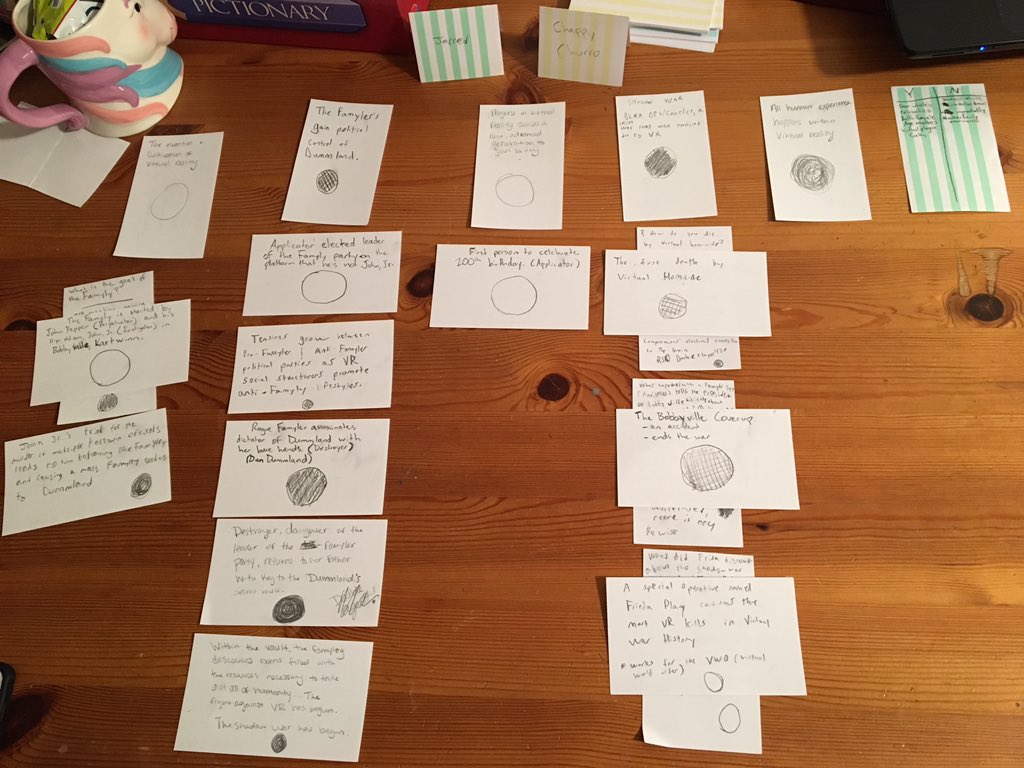
Microscope is basically a extremely large scale group storytelling game, it feels like a writers workshop/improv game. I won't explain too much of it, as that would give the game away, but basically you create a beginning and ultimate end of a free form story, (so no dice rolls, no GM or referee) and then through the games' rules, flesh out major events, time periods, and act out small scenes along the way.

This is what it usually looks like.
Photo Credit
I explained the gist of it to some of my other table top pals who hadn't played it,  and a big question some had was: if it's so free-form, why have rules at all? Why not just story-board and create scenes as a group? While the rules are light, the ones in place are extremely effective in guiding play, forcing you to think outside the box. The order in which dictates who contributes to the story, what topics are going to be focused on, and who is going to be who in a scene is carefully laid out, forcing the group outside their comfort zones, creatively speaking.

It works well, I could see it maybe being good for collaborating on a world/setting with your players, and then using another system to enter the setting, but because after the initial discussion on the themes of the game and what will be focused on/banned,  you can add whatever you want, kill whoever you want, it can easily go off the rails. This is very much part of the fun, but unless your pals are die-hard dramatics, things are likely to take a silly turn, no matter the seriousness of the game.

Another note, I think this is a very good way to get someone who is not as comfortable with role-play or improv to get comfortable contributing ideas to a narrative, etc. I'd throw it on the pile of "great games to start a group off with" (other examples being Everyone Is John, and Dread) 

Friday, October 5, 2018

1d6 Weird Things Around The Wizard's Tower (Plus 1d10 fish tanks)

I love wizards, they fuck everything up for everyone. Something about a high-level nerd who has abandoned all morality in the quest for arcane power strikes me as hilarious.And naturally, for my very gonzo style nothing gets me goin more than a wizard tower fulla random stupid shit. Here's a list of that. I went kinda over-board with the fish.

1. Floating fish tank- a ball of water floats around the room, with fish or other exotic sea creatures in them. Great for studies or other brooding spots. Not so great for parties (lots of dead fish).
There are a bunch floating around the room, wide circular arcs:

  • Standard exotic fish, not harmful, but getting smashed into one hurts like hell (1d4 damage) and you have to live with the death of a fish on your hands. Unless otherwise noted, all glass bowls do this damage when either knocked into or used as a throwing weapon. 
  • A razor fish  in just a floating sphere of water, no glass. Inside is a small island with a toy castle and some (real) gold pieces. Smashing the ball around won't pop it, the enchantment that holds the water is inside the castle, and must be dispelled. It would be difficult to hit the piranha  inside, as the dispersion of the water flows around strikes in unpredictable ways. No glass means being hit by it doesn't hurt, but sharing a square with it means taking 2d6 plus a chance to bleed, cutting yourself on the razor fish. 
  • A bowl with a very poisonous jellyfish (fort save or slowly paralyze 'till suffocation), nearly invisible to the normal spectrum of light, making the bowl seem empty. There's a shiny diamond hidden in the sentiment of the bowl. 
  • Waterless tank full of colorful hermit crabs. Each actually is a vessel for a potion, eating a crab will count as "drinking" the potion. Red is for Healing, Blue for Resistance to Cold, Green for Cure Disease, and purple for Hermit Crab Empathy (a turn for each crab eaten, doing nothing but sobbing loudly for your crimes)
  • A wishing fish. The wizard caught the wishing fish and let it go, and then wished for it to stay in this bowl forever. This makes the bowl indestructible and immovable in its wide arc moving through the room. It stares at you knowingly, and pityingly. 
  • Space Lobster. Its tank is a perfect square, and is full of acids essential to the creature's survival. (3d6 damage instead of normal on a contact smash). The lobster dissolves out of this dimension when the glass is broken. 
  • Sentient Coral, there are a few of these things floating around, and if all removed and combined in a larger container, it becomes a powerful psychic being. Very polite but very evil. 
  • Scroll Fish: Spell scrolls or a copy of the wizard's spellbook, written on thin white fish with long bodies. Impossible to read unless given a specific type of fish food, then form into the right order. The fish food is hidden somewhere else in the tower. 
  • Angry water elemental - if glass is broken it will be freed. 50% of ally or enemy. 
  • Mantis Shrimp - Glass is as tough as Adamantine. If broken or somehow opened, the Shrimp becomes giant. God help you. 
Put these in a room with a random encounter and hilarity should ensue. 


2. Chess Robots- Two large sophisticated robots (or golems if you wanna go that way) sit blocking the entire room with their large computational bodies and a small board game between them. They are equally brilliant and cannot beat each other.

A turn may take decades of computing and the robots will NOT tolerate any risk of the board pieces being jostled. This is reinforced with save-or-die death rays, which will be calmly explained to newcomers.  They are happy to provide passage across the room for knowledge of other games.

Additionally, they have not learned the concept of cheating, which they will be very thankful for, and use to break a dead-even, decade long tie. Return visits after teaching the bots cheating will result in the bots continuing on as normal, but with their death rays trained on each other as a deterrent.

3. Forgotten Experiment - Gnashing teeth on twitching hooves, its braying and pleading for death. It probably cannot die. It would happy to help you kill the wizard, but it breathes noxious gasses and words come out in a broken version of the spell tounges - making its speech always unrecognizable.

4. Vacuum Room - completely devoid of atmosphere, probably being used to assist with temperature control in some experiment somewhere in the tower. Or, as always, perhaps just for the hell of it. The doors are unlocked but sealed tight, with a sign that says "Warning Do Not Open" in a magical, understandable-by-all rune. Opening leads to a explosive decompression. Strength to grab on to something or get smashed for like, 5d6 damage or something. Put breakable shit in here if you want to be more mean.

5. The Thing in The Box - It is large and made of metal. There is something inside. It cannot speak, but it does tap from the inside of the box. Somewhere there is a book which can translate the morse code. It can answer questions and the first few will be very reliable and useful. The next few will be useful, believable lies. The ones after that will be lies spun so well that when they go horribly wrong, it won't seem The Thing's fault. It's a slippery slope after that. You'll probably wind up becoming a wizard.

6. Dusty Workout Room -  Abandoned and pathetic sets of weights litter the room. An animate training dummy weeps, for it has not known any living contact in a century. Fairly powerful magical melee weapons just lie around. If the wizard finds out you were in here, they will hunt you down out of shame.

Tuesday, September 11, 2018

Hirelings and Loot, Everyone Loves Random Tables

Ehh it's been awhile, i moved to philadelphia, i got some new jobs, but i also got some things coming up, promise.

1d4 Strange Hirelings
These fellows are all non-combatants, you pay them a flat fee, if they were to fight, they would want a share of the treasure.

1. Jerry "Packem Good" and his donkey, Stealin’ Dan.
 Teamster. Packs stuff really well, comes with one donkey supplies  Helps carry stuff, and does so much more efficiently. The exact benefits of this are up to you, but the guy is really, really good at his job. Can manage also a convoy of lifters.
Cost: 1 Silver a week, plus food expenses.

2. Chug the Mutant: Dumb idiot with large brow. Does basic lifting, shoveling, hard work stuff. Very cheap, does better if being managed.  Has two brothers, Thug and Rhug that can also be hired for the same price. (3 Copper a week)

3. Lemmy the Linkgirl: She's a sickly orphan with a bad cough. Lantern/Torch Bearer. Cannot do heavy labor or carry lots of equipment. Probably not contagious, but everyone seems really eager to send her out on an expedition.
 Cost: I dunno, just feed 'er.

4. PUZZLE WIZARD: Suicidal super genius. "Wants to kill himself but we talked him into solving one more puzzle before that."  Will not help in combat, will only solve one issue, puzzle or way around some trap before blowing his fucking brains out. If he is killed in a way that doesn’t involve a swift suicide he promises “I’ll fucking curse the fuck outtaya, and not in a fuckin good way everyone respects!” (He's not joking, come up with the most fucked curse you can think of)
Cost: Wants 300 platinum for his next of kin, a hardworking niece in a distant city..Can feed himself with FOOD MAGIC.

1d6 Loot Table:

1. Dimensional Slide Ring
A ring with an inset numbered slider, the farther you go up, the farther you are removed from this dimension, both you and enemies have a miss chance of up to  75%. The ring turns very slowly. Turning it past 75 gets you sucked into another parallel dimension forever. Turning it past 0 "grounds" you in this world more, probably as dimensional anchor. 

2. A Map to Two Relics of The Past
A an old map lead you to a dusty field deep in the desert. Excavation of this area will lead to the discovery of a strange metal box, with a vampire inside. The box is actually a well preserved  1957 Plymouth Belvedere, if not destroyed immediately, the vampire will demand to know if "gasoline has been invented yet" The mechanics of the car will be worth thousands, but let's be honest, your players are just gonna try to drive it.

3. Scroll of Summon Banana
Actually a scroll of Summon Hungry Gorilla

4. Small Box of Connections
Plastic Brick phone with a few numbers on the back, each a extrademensional advisor on the other end. 1 out of 6 chance of breaking for good after each call. Calling each number is as follows:

  • Mancierge: Old sounding fella, knows good restaurants and spots in any populated area, but he takes a long time flipping through his notes. However once you go, within 1d6+2  weeks it will be filled with aging retirees and no longer cool ever again. 
  • Lawyer: Lawful Evil, but contractually has your back. Perfect for selling your soul or wishes with suspicious genies, "*sigh* sir, just put satan on the phone please." 
  • Crisis Negotiator, excellent negotiator in any situation, but put off if it's not really an emergency. 
  • PUZZLE WIZARD's ghost from the afterlife. See above but he's super mad that he still has to do this shit now that he's dead, but that's the trouble with being the best. Will never solve puzzles at this state, only give one hint per call. 

 5. Letter from yourself
It's real, and it has some useful advice, particularly a warning about something to come. One free reroll that is available for 24 hours after reading.

6. Jet Black Teeth
These teeth have arcane writing all over them, and if a magic user replaces their teeth with them, they get a extra permanent spell slot. These were the teeth of an old, evil, but well known spellcaster, a few people may remember him, and may have mixed reactions to you wearing his teeth.


Wednesday, February 28, 2018

Speed of Light Moths.

I had this idea for a room in a dungeon while I was in the shower, I have no fucking clue what to do with it, but let's flesh it out.

Spooky
So it's a room, plain stone, with a door on the
opposite end. On the door, are some moths. Moths are the menacing cousin of the butterfly. They are formed up in the shape of an 8 or maybe in an infinity loop. Upon going through the room, the moths are disturbed, they flutter around the room in a panic. Exiting through the opposite door only leads to finding yourself back at the original entrance to the door. The moths once again in place, in the same shape, and any other changes to the room seem to have reset. However, before the players react, the moths fly off the door, a little quicker than when they were originally disturbed, the door flies open, all without any action from the party.

Following through the opposite door again leads to the same results, but with even more drastic results.

 What's going on in here?
 Each time the group heads through the other door, they return to the room, but any force that acted on anything in the room is repeated but with compounding multiplication. So the moths get disturbed once, and the force that disturbed them is still there the next time the room is entered (their little wings beating against the door, the door opening, etc.) Eventually, (and it only takes a few more passages through the door) the moths will rocket towards the players like tiny missiles, massive groves will appear in the ground where people walked, the door will likely smash itself off its hinges. God forbid they did something like hit a wall or use a bomb.

How do they escape? I'm not sure. Maybe they can just walk back out the door they came in from, at any point during the loop. Maybe there's a secret trap door that's hidden somewhere in the room. I kind of like it as just an interesting way to use a dead end in my next dungeon, maybe just a thing the players can experiment with, and then use on a monster or to help with a puzzle later on. Maybe chuck some coal in there, and with enough work and care, they can turn it into a diamond or something.

Maybe make the room larger, with multiple doors, and only a correct sequence through them lets you out, any other just compounds the force as above. Stick some mundane things in the room like a little stream, and within a few walks through the room, the river is now a massive canyon, or the water is moving at speed of a pressure washer.

Thursday, January 4, 2018

The Sound and the

When The Church, on its 2nd Grand Crusade slew the Titan Bard Apology, the massive god being let out its voice in a long and low howl. This howl crossed the globe, passed by the Capital of The Dove and smashed The Burning Cathedral's western spire before disappearing forever. This was the first, and greatest, sound elemental.


It's cool because animals kinda give emotion to noise too. 
Sound Elementals are noise given emotion and basic "life" the same as other elementals. However what distinguishes a Sound Elemental from say, a Fire, is that the emotion which formed it can vary in far more drastic ways. We attribute feeling to fire and water and etc. Fire is warm, angry, passionate but it isn't intrinsically any of those things, we assign emotion to fire in our poetry and metaphors. Sound is really just another thing, a bunch of waves that vibrate our ear bones and shit. But we give it emotion, from a haunting tune, a warning growl, a love ballad.

So sound elementals are born with a variety of purpose, though often it is by accident. As I keep discussing magic is linked to everything in Oris, so sound elementals can come from thin air when the circumstances are right. Usually these circumstances are: get powerful quantities of magic and emotion, and expose those to sound of some kind. This births the sound elemental.

Sound Elemental
They don't look like anything, you can only hear them. A love based elemental may sound like a flowing beautiful song, or just a warm note, a elemental birthed from fear may just be a shriek, a war ballad elemental might be thundering footsteps, or a ball of insults. Stats are difficult, and vary on the situation, they don't have HP, never have particularly high INT, but strength, dexterity, and charisma would vary on the situation and type of elemental.

Movement: "Flight" 60ft, perfect.
Attacks: 
Too loud and too close
The simple art of making people deaf, when someone with eardrums or similar audio receptors is near a sound elemental, and the sound elemental is actively hostile to them, they take 1d12 damage. On a 12, fort save or have your eardrums burst.

Slam
Sound waves have very little control over the environment, but can manipulate small bits of matter, but unless the elemental is particularly strong, whipping this matter at people is going to do nothing. Let's say the slam is a 1d4 + STR (With the average elemental's strength usually being a -4)

Mass Embolism 
Powerful enough Sound Elementals (usually ones borne from hate and war)  can cause major organ damage with their sheer volume, fort save or 1d12 CON damage. On a twelve, roll a d20, if that crits, the target has a severe stroke and is dead.
Alternatively, special bred quiet assassins can achieve this same effect not through volume of sound, but through ultrasonic vibrations.

Naturally, bards are the biggest users and creators of sound elementals, they can be used as weapons, messengers, ambiance adjusters, and more. But more often than not, these elementals are made by accident. Big musical shows often spawn plenty small versions of the creature. Traumatic events associated with noise also can bring forth the elementals, sites of war or large explosions.

There are also plenty of incidents of magically powerful youth creating a sound elemental from a song or other passionate expression, and then it proceeds to blow the eardrums out of the local bully, or breaking every glass in the farmer's daughter's room with a romantic violin shrill.

In general, a rampaging sound elemental can be a good plot hook, they require some unconventional tactics to fight.

Fighting sound elementals
Can't be done in the usual sense, physical attacks simply have nothing to hit. No, not even magical ones. Nevertheless, they need to be dealt with occasionally. Locating them can be tricky, they're fast, invisible, and can blend in to background noise quiet easily, especially in crowded places. Players would do well to follow not a specific sound, but certain sounds that are associated with the feeling that is being searched for. The argument coming from nowhere in particular

Firstly, they can be tricked. The average elemental is not intelligent, it is emotion, not reason. They are fooled by disguises and play acting. A lusty sound elemental may be tricked by it target just telling it, "yes, I am very much in love with you now". A more violent elemental just needs an elaborate death scene by one of your party members in a wig with a bunch of pig's blood spread around.

Drowning: you gotta be loud, loud enough for the elemental to be unable to remember itself. Dilute it with white noise, scream, beat your shield. Got a elemental speeding around the city? Start ringing ALL church bells. The poor thing will just start imitating the bells and dissolve into them, like a cube of sugar into a pond.

Existentialism: A critical part of a sound elemental is being heard. Sound exists when we aren't around, obviously, but if a elemental is convinced it cannot be heard, it can break itself apart.

Bard Spell: Summon Sound Elemental (Level 1-5)
Summon a Sound Elemental which will perform a task until it is completed (Gm's discretion). The higher the level, the higher the intensity of the sound, the longer its duration, and the more complex commands it can be given.
Level 1: Emotion or verb ("Kill", "Defend", "Merriment", "Anger") Lasts for a minute or two, or a single action or attack.
Level 2: Emotion or verb + subject ("Protect me", "Seduce Jessica", "Calm dog") Lasts for a few rounds, or three or four actions
Level 3:Full sentences worth of commands, bonus points if in prose. Lasts until the end of combat, or about an hour, can perform multiple actions.
Level 4: Full sentences, lasts most of the day, can perform a complicated task with multiple steps.
Level 5: Any type of command, interpreted very well, basically just manifested will of the spellcaster. Extreme duration, can operate for a few days unless destroyed.

Alternatively a elemental can be given the name of a song at any level, while effectiveness and actions will be determined by the GM.

Most people assume the Bard Titan Apology's elemental was a sound of vengeance and fury against the church. After all, the Burning Cathedral was nearly destroyed when its spire collapsed, and to this day the harmonics in the building make your eyes water.  It was actually just a sound of primal fear, however, the emotion was "Escape death!" and the elemental just happened to knock over a bunch of stuff on its flight away. It still exists, on the southern primordial planes of the moon, a whimpering note recurring within the massive bones of his mother's womb.